Have your students mastered letter sounds and decoding CVC words? If so; it’s time to move on to consonant blends. Read more about consonant blends and check out tips for teaching blends to your beginning readers.

Check out these related posts:
- How to Teach Phonics in Kinder
- Strategies for Teaching Decoding
- Science of Reading Alphabet Activities

What are Consonant Blends?
A blend is made up of 2 or 3 consecutive consonants in a word or single syllable. Each consonant represents its own sound and is pronounced in the blend. Blends with 3 consonants are sometimes referred to as consonant clusters. Blends can be found at the beginning and end of a single syllable.
The most common beginning blends are below.
- L-blends (cl, pl, bl, gl, sl, fl)
- R-blends (br, cr, dr, pr, tr, gr, fr)
- S-blends (sc, sk, sp, sn, sm, st, sw)
Final blends are found below.
- Final T-blends (-ct, -ft, -pt, -st, -lt, -nt, -xt)
- Final L-blends (-lp, -lt, -lb, -ld, -lf, -lk)
- Other final blends (-nk, -nd, -sk, -mp, -sp)

How to Teach Blends
Students are ready to begin working with blends when they are able to segment and blend sounds in CVC words. Blends do NOT have to be memorized as students are still attaching sounds to print as they blend the sounds together in a consonant blend.
Introduce blends with 2 consonants first. Students need to understand that each consonant in the blend retains its own sound as they decode and encode words with consonant blends.
As with all new phonics skills, follow a structured and explicit instructional routine when introducing consonant blends.
- State the purpose of the phonics lesson.
- Warm-up with phonemic awareness activities. – Orally blending and segmenting words with blends.
- Review previously taught phonics skills.
- Introduce the new concept (consonant blends). – A blend is a grouping of 2 or 3 consonants in a syllable or word. In a blend, each letter in the word keeps its own original sound.
- Guided Practice – Practice decoding & blending words with blends, say, tap & map sounds, and build words with blends.
- Extended Practice – students can sort words with the targeted consonant blend, match pictures to words, and tap & map words.
- Practice encoding by writing words, sentences, and/or a story using words blends.
- Read decodable text. Practice reading decodable passages and readers with the targeted consonant blend.
Blends Phonics Books & Teaching Slides
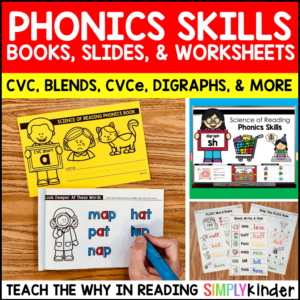
Teach blends using Simply Kinder’s Phonics Skills Blends Set found HERE. Each set includes teaching slides, phonics books, and worksheets.
Teaching Slides
Introduce blends to your students with 14 interactive slides designed to teach the phonics skill. Warm up with phonemic awareness activities, teach the concepts and rules of the blends, and practice decoding, mapping, & encoding words with blends.
Phonics Books
Students can use their own interactive phonics books to follow along with the teaching slides. Each book guides you from phonemic awareness to decoding and encoding. Each activity progresses in alignment with your lessons. Students learn the “why” behind decoding words with blends so they can apply this skill to other words. Format the book to fit your classroom needs by choosing as many or as few pages as you need for each blend.
Phonics Worksheets
Choose from a variety of blends worksheets to reinforce skills with students. Worksheets cover the concepts, rules, and “why” of blends. Provide students sheets that give them more practice with decoding, mapping, and encoding words with blends.
Tip: Send a copy of the blends information sheet home with students so parents can reinforce the skill at home and help students read words with blends.

Other Tips for Teaching Blends
Check out these additional tips for teaching blends.
- Word Mapping – Providing practice with Orthographic mapping is SO important for students to build fluency with reading and encoding words with blends. Students say the word, tap the sounds, map the sounds, and graph the sounds. Use Simply Kinder’s Word Mapping Bundle found HERE for fun, seasonal options.
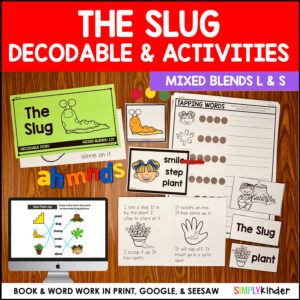
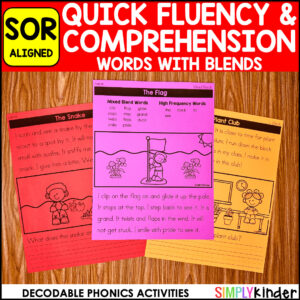
- Decodable Readers & Passages – Give students relevant practice reading words with blends through decodable readers. Have students highlight, circle, or underline words with blends before reading the decodable text. Grab Decodable Readers from Simply Kinder to cover all of your phonics skills HERE.
- Manipulatives – Students can use bingo chips, snap cubes, or colored tiles to segment sounds. This is especially helpful for students to pay close attention to the extra consonant sound in a blend.
- Blending Hands – This simply activity is great for 2 letter blends. Students attach each sound to a hand and then make a blending motion with their hands as they blend the sounds together.
Prefer to shop individual resources?
Choose what you need from the Simply Kinder shop. These resources are also included with Simply Kinder+ Unlimited.
-
Product on sale
 Kindergarten Phonics Worksheets, Phonics Booklets, Slides, Posters, Packets, Science of ReadingOriginal price was: $100.00.$15.00Current price is: $15.00.
 -
Blends Decodable Reader, Science of Reading Decodables$5.00
-
Product on saleBLENDS Quick Decodable Reading Fluency Passages & ComprehensionOriginal price was: $8.00.$5.00Current price is: $5.00.

What are your tips for teaching blends? Please make sure to tag us on Instagram here or share inside the Simply Kinder Teacher Facebook Group here.