Learning to decode words is not a natural skill and must be explicitly taught to young readers. We want students to become fluent decoders so that vocabulary and reading comprehension can blossom. The great news is that teaching students to decode efficiently doesn’t need to be complicated. Check out these strategies for teaching decoding.

Check out these related posts:

Importance of Decoding
Students learn to read by decoding words. This requires them to break words (segments) into individual sounds and blend them back together. Decoding is foundational for pronouncing, reading, and spelling new words. Decoding will begin as a slow process but will become automatic as students learn new skills. Repetition and meaningful practice are necessary for students to become strong decoders and fluent readers.
SoR-Based Decoding Strategies
Teaching your students decoding strategies grounded in the Science of Reading is the best place to start when teaching decoding strategies. These are the components to remember when teaching strategies:
- Point and say each sound.
- Slide the sounds together continuously.
- Try a different sound (vowel sound, digraph, etc)
- Think about what you know (phonics rules that have been explicitly taught).
- Break words into syllables (closed, open, silent e, vowel team, r-controlled, consonant -le).
- Separate word parts (prefixes, suffixes, bases, and roots).
- Does it make sense? Does it sound right? – Encourage students to monitor their reading.
First, teach students to point and say each sound and slide words together continuously. Begin adding in other decoding strategies as you systematically work through phonics skills. For example, trying a different vowel sound would not be appropriate until students are exposed to long vowel sounds.
Grab your FREE Smiley’s Super Reading Strategies Posters and Bookmarks from Simply Kinder + HERE. This set includes posters to display in your classroom and bookmarks that students can use when reading independently.

Decodable Readers
Getting decodable readers in the hands of your students will provide the opportunity for them to apply the specific strategies and skills they are learning. They reinforce decoding, blending, and literacy skills. Decodable readers should be chosen based on the phonics skills that have been taught so students can decode the words. Decodable readers ensure that students are cracking the code to words and not guessing based on a cueing system. Consider this routine when using decodable readers with your students:
- Clearly state the focus of the small group – We are focusing on short /o/. Say the sound together, utilize your sound wall, and show students words that have the targeted skill.
- Incorporate Word Work
- Book introduction
- Read the book as a whole group
- Discuss the text for comprehension
- Students re-read independently using strategies
- Allow time for word work practice (independently or partner)
Read more about using decodable readers with your students HERE.
Simply Kinder has you covered if you are looking for decodable readers. Grab the NEW Beginning CVC decodable readers in the bundle HERE and get started using decodable readers in your classroom.

Hands-On Decoding Activities
Give your students hands-on practice with decoding. Check out this list of hands-on decoding activities to use with your students.
- Blending Road – Students will map words into phoneme boxes and use a Hot Wheels car to blend the word quickly. Grab your FREE Blending Road set HERE from Simply Kinder +.
- Playdough Decoding – Students will squish balls of playdough that represent the phonemes in words as they decode and blend.
- LED Lights – Attach LED lights to a whiteboard. Write graphemes above each light. Students will tap and turn on each light as they say each sound. Students will then blend the sounds together.
- Decodable Headbands – This is a fun partner activity that strengthens decoding and encoding skills. Each partner has a sentence strip headband and uses paper clips to attach decodable words to the front of the headband. Partners take turns decoding the word on their partner’s headband while the one that is not decoding writes the word that their partner reads. Students check to see if their partner matches the word on the headband. Students continue taking turns decoding and encoding words.
- Blending Cards – Use Simply Kinder’s Decoding Cards found HERE or notecards to create binder rings of decodable words. Build a set for each new skill you cover. Students can use fun pointers to practice decoding and blending words. Let your blending sets grow and place them in an easy-to-access place so students can practice blending and build fluency all year long!
- Magnetic Cubes – students use magnetic linking cubes with graphemes written on them to decode. Students snap the cubes together to blend quickly.
Prefer to shop individual resources?
Choose what you need from the Simply Kinder shop. These resources are also included with Simply Kinder+ Unlimited.
-
Product on sale
 Kindergarten Phonics Worksheets, Phonics Booklets, Slides, Posters, Packets, Science of ReadingOriginal price was: $100.00.$15.00Current price is: $15.00.
 -
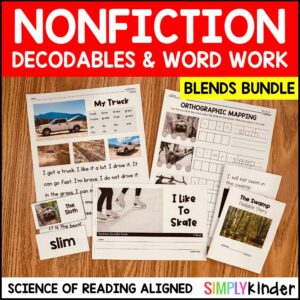
Nonfiction Blends Decodable Readers with Real Pictures, Passages, Books with Word Work$6.00
-
Product on saleDecodable Readers Kindergarten, Science of Reading, CVC Decodable Readers BooksOriginal price was: $625.00.$15.00Current price is: $15.00.
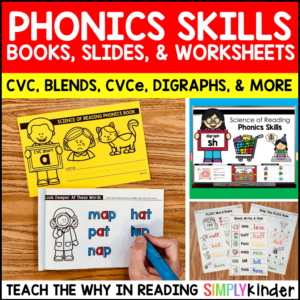


Your students are going to soar with decoding this year! Join Simply Kinder + printable membership here and snag tons of resources to target decoding & more in one place for one price!