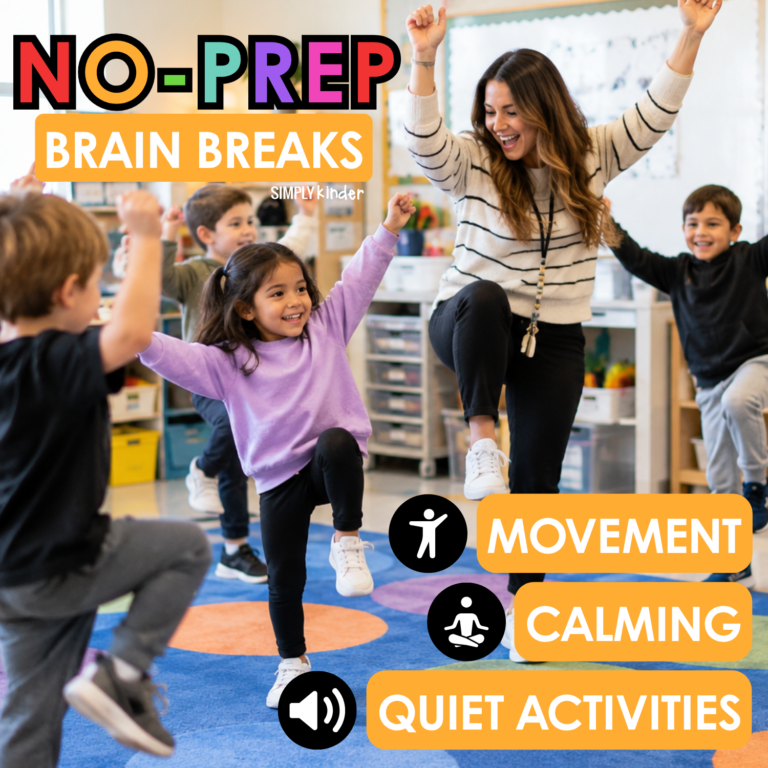
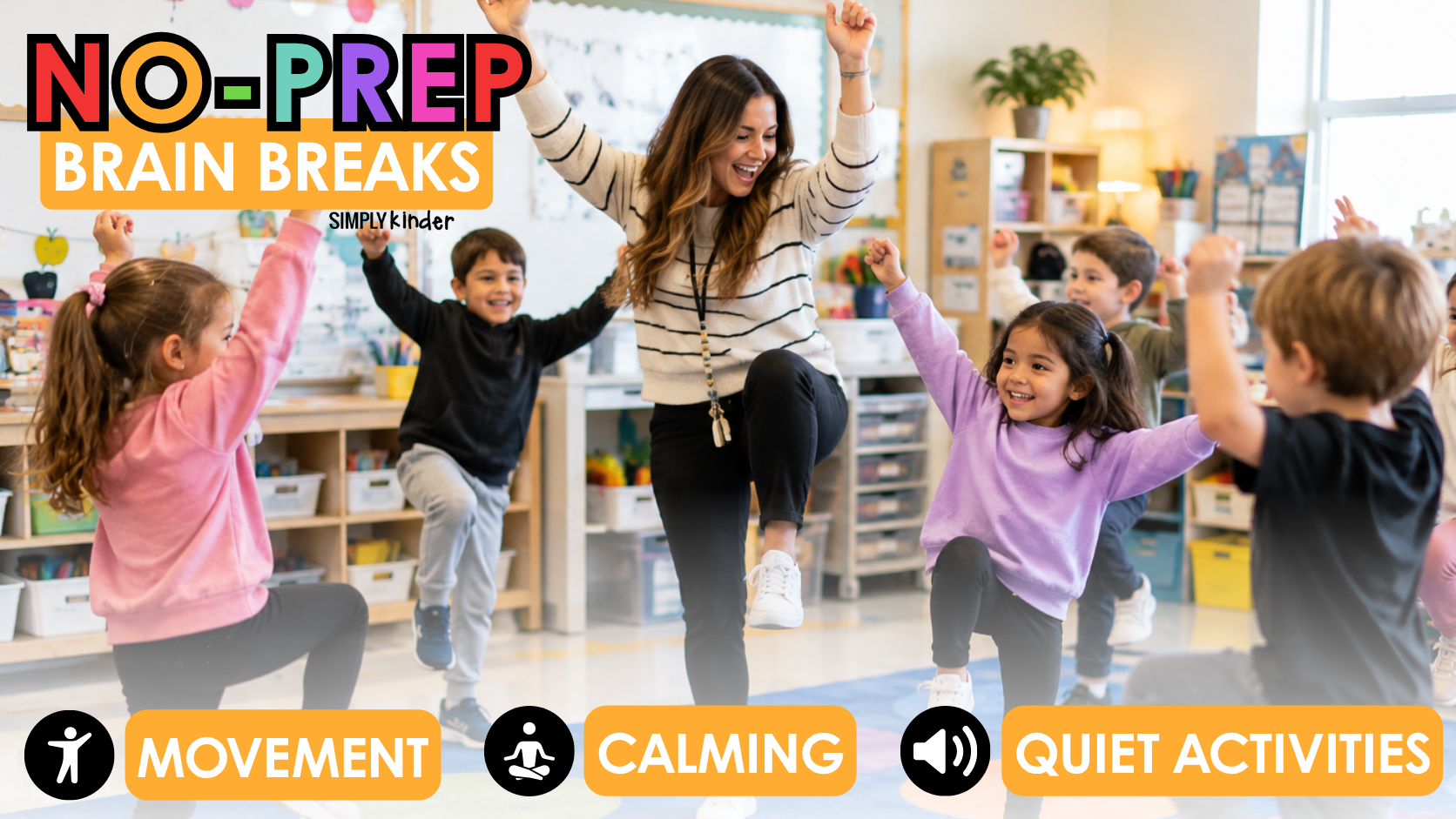
Not every brain break needs to get students up and moving. Sometimes your kindergarteners need to burn off a little energy. Other times, they need a quiet activity that helps them slow down, refocus, and stay engaged. Having a mix of energizing, calming, and quiet brain breaks gives you more options throughout the school day. Best of all, these activities require no videos, special materials, or advance preparation. Check out these no prep brain breaks for kindergarten!
Teach Start and Stop Signals
Before using brain breaks during a classroom interruption, explicitly teach students how each routine works.
- Choose a start signal. Use a familiar phrase, visual cue, or classroom doorbell to tell students when to begin.
- Teach a stop signal. For example, raise your hand and teach students to finish their movement, put their hands in their laps, and look at you.
- Model expectations. Show students how to stay in their own space, keep voices quiet, and use gentle movements.
- Practice together. Begin with 10 to 20 seconds, then give the stop signal. Repeat until students respond consistently.
- Rehearse while you supervise. Briefly turn your attention to a classroom task while remaining present and able to monitor students.
Get Classroom Resources You’ll Love


Energizing Brain Breaks for Kindergarten
When students are wiggly or need to move, try these quick activities.
- Animal Walks: Hop like a bunny, stomp like an elephant, or waddle like a penguin. Students can move in their own space.
- Freeze and Move: Call out a movement, such as marching or wiggling. When you give the stop signal, everyone freezes.
- Copy My Moves: Clap, tap your shoulders, or reach overhead. Students copy your movements, then take turns leading.
- Number Moves: Call out a number and have students clap, tap their toes, or jump that many times.
- Silly Story Movements: Tell a short story about visiting a farm, exploring the jungle, or traveling through space. Students act out the story as they listen.
Calming Brain Breaks
Sometimes students need a quieter reset instead of more energy.
- Stretch and Breathe: Reach up, stretch gently from side to side, and relax your shoulders.
- Grow Like a Flower: Start curled up like a seed, then slowly stretch tall like a growing flower.
- Finger Patterns: Show a sequence such as one finger, two fingers, a fist, and an open hand. Students repeat the pattern quietly.
- Trace Your Hand: Use one finger to trace around your opposite hand. Students can move slowly and breathe comfortably.
Quiet Brain Breaks Students Can Do Independently
Quiet routines are especially helpful when you need to assist a student or handle a brief classroom interruption. Teach these activities ahead of time so students know what to do while you remain present and supervise.
- Finger Tapping: Touch your thumb to each fingertip, moving slowly from one finger to the next.
- Rock, Paper, Scissors: Students make the three hand shapes in a familiar sequence, repeating it silently on their own.
- Silent Counting: Count from one to five or one to ten on your fingers, then count backward.
- Alphabet fingers: Quietly think of a letter and make it in the air with one finger.
Prefer to shop direct? We’ve got you.


Which Brain Break Should You Choose?
| What Students Need | Try This |
| Release energy | Animal walks |
| Wake up and refocus | Number moves |
| Slow down | Stretch and breathe |
| Quietly engage their hands | Finger patterns |
| Practice independence | Finger tapping |
| Settle before learning | Trace your hand |
Brain Break Routines that Work
You do not need to teach all brain break ideas at one time. Start with one energizing activity, one calming activity, and one quiet independent routine. Practice each one during a time when you can give students your full attention. Once the routines become familiar, you can use them more naturally throughout the day.
The goal is to help students learn what they can do with their bodies and attention when they need a reset, while keeping the classroom safe and predictable. A few well taught routines can give you more flexibility, help students build independence, and make transitions feel smoother for everyone.