Teaching alphabet letters and sounds in kindergarten is one of the most important parts of building a strong foundation for reading. When students understand that letters represent the sounds they hear in spoken words, they are beginning to unlock the alphabetic code.
The best approach includes explicit instruction, phonemic awareness, phonics practice, letter formation, and plenty of opportunities to connect sounds to print.
The goal is not simply for students to memorize 26 letters. We want students to understand how letters and sounds work together so they can eventually use that knowledge to read and spell words.

Check out these related posts:
- Science of Reading Alphabet Activities
- Activities to Teach the Alphabet in Kindergarten
- Sound Wall Instructional Tips
GRAB THE RESOURCES YOU NEED FROM SIMPLY KINDER INSIDE THE UNLIMITED PRINTABLE MEMBERSHIP HERE!

OR GRAB THESE ITEMS FROM THE SHOP HERE:
Teach Letters and Sounds Explicitly
Kindergarten students benefit from clear, direct instruction. When introducing a new letter, try a simple routine:
- Say the sound. Model the sound and have students repeat it.
- Show the letter. Introduce both uppercase and lowercase forms.
- Connect sound to print. Explain that the letter represents the sound.
- Practice the letter. Have students form the letter while saying its sound.
- Use the sound. Find the sound in words or use it to read and spell simple words.
For example:
“This is the letter M. M represents /m/. Say /m/. What sound? /m/. Map starts with /m/.”
This consistent routine helps students make the connection between what they hear and what they see.
Tip: Simply Kinder’s Alphabet & Sound Slides make this routine foolproof. Check out the entire collection of Alphabet & Sound Slides at Simply Kinder + HERE!

Do Not Forget Phonemic Awareness
One of the biggest mistakes we can make when teaching letters and sounds is assuming students automatically hear the sounds in words. They need opportunities to practice listening to and manipulating sounds.
Phonemic awareness is the ability to hear and work with individual sounds in spoken words. Students may practice blending sounds, segmenting words, identifying sounds, or changing one sound to make a new word.
For example:
“Listen to the word sun. What is the first sound you hear?”
“/s/!”
Then you can connect that sound to print:
“Yes! /s/ is represented by the letter S.”
This creates a strong bridge from sounds to letters.
Easy Alphabet Activities for Kindergarten
Alphabet practice can be done in a whole group setting, small groups, literacy stations and independently. Try these simple activities:
Sound Hunts
Choose a target sound and have students find objects around the classroom that begin with that sound.
“Find something that starts with /m/.” Create an anchor chart of objects students find.
Sound Sorts
Give students pictures or objects and have them sort them by beginning sound.

Mystery Letter Bag
Place letters that you have learned in a bag. Students pull out a letter, name it, and produce its sound.
Once students know enough sounds, have them pull several letters and build a word.

Alphabet Crafts
Create adorable uppercase and lowercase alphabet crafts to reinforce the connection between sound and letter. Build the letter, say the sound, and make the connection.
Browse Simply Kinder’s uppercase alphabet crafts HERE and lowercase alphabet crafts HERE!

Multisensory Letter Practice
Have students practice letter formation using:
- Play dough
- Sand
- Magnetic letters
- Dry erase boards
- Chalk
- Gel or Paint Bags
- Finger tracing
Encourage students to say the name & sound as they form the letter.

Alphabet Pre-Readers
If your students are not yet ready for decodable text but you want them working in readers then emergent readers are great option.
Check out the library of Alphabet Pre-Readers at Simply Kinder + HERE!
Prefer to shop individual resources?
Choose what you need from the Simply Kinder shop. These resources are also included with Simply Kinder+ Unlimited.
-
Product on sale
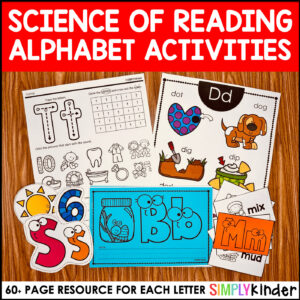
 Alphabet Activities Kindergarten, Science of Reading Alphabet Posters & MOREOriginal price was: $104.00.$12.00Current price is: $12.00.
 -
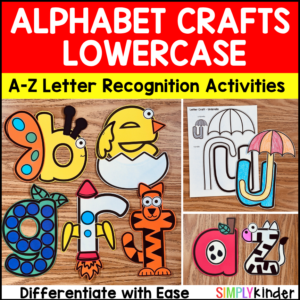
Product on saleAlphabet Crafts, Letter Phonics Activities, ABC Practice, Preschool KindergartenOriginal price was: $11.00.$6.00Current price is: $6.00.
-
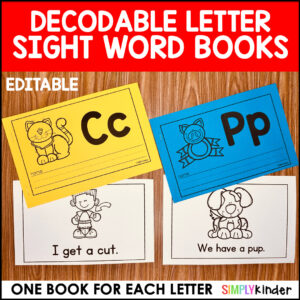
Product on saleAlphabet Books with Editable Sight Words, Printable Alphabet Sight Word BooksOriginal price was: $10.00.$6.00Current price is: $6.00.

Keep Reviewing
Students need repeated practice to make letter and sound knowledge stick.
Build quick review into your day:
- Review previously taught sounds during your morning routine.
- Practice letters during small groups.
- Include letter and sound games in centers.
- Use writing time to practice letter formation.
- Review sounds before introducing a new phonics skill.
Short, frequent practice can be much more effective than one long alphabet activity.
Simply Kinder’s Alphabet Directory
Support is ready for every letter from A to Z with Simply Kinder’s Alphabet Directory. Choose the letter you are teaching and find slides, crafts, tracing pages, books, sound activities, notebooks, centers, games, digital practice, writing, and more!
Start browsing the Alphabet Directory at Simply Kinder + HERE!
FREE PRINTABLE

Support proper handwriting habits with this FREE Letter Formation Printable! These easy-to-use reference pages provide clear visual models for forming both uppercase and lowercase letters, making them a valuable tool for students, teachers, classroom aides, and families.
Download it for FREE on Simply Kinder + Printable Membership HERE!